THE DOOR OF THE MONTECASSINO ABBEY

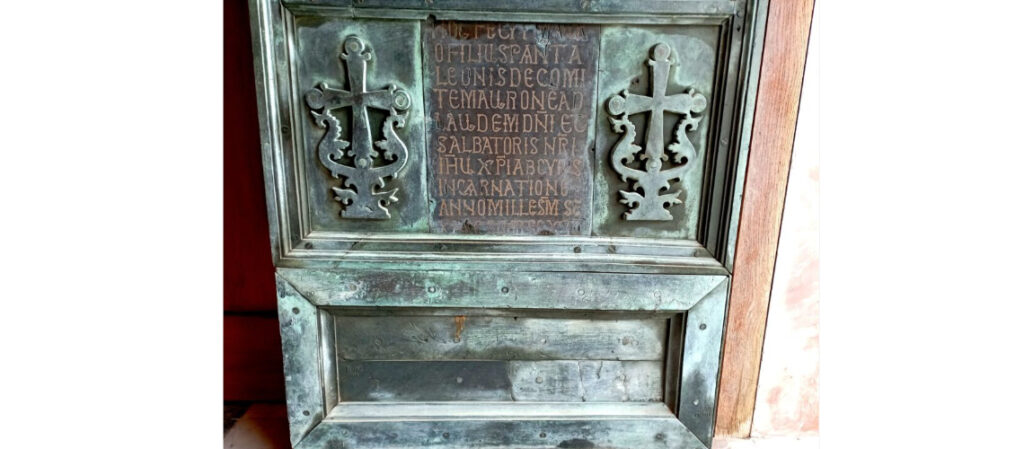
Desiderio, descendant of a princely family from Benevento, became abbot in 1058 [Photo 1]. The Cassino monk Leone Marsicano in the “Chronica monasterii Casinensis” wrote that around 1065 the abbot Desiderio, while he was architecturally renovating the monastic complex of Montecassino (the reconstruction took 5 years) was struck by the beauty of the bronze door of the Amalfi cathedral [Photo 2,3]:

“Since his eyes were enchanted, he immediately sent the measurements of the door of the old church to Constantinople, along with the order to build the door as it is today. He had not yet decided to rebuild the church: this is why the door was so low, as it remains today.”
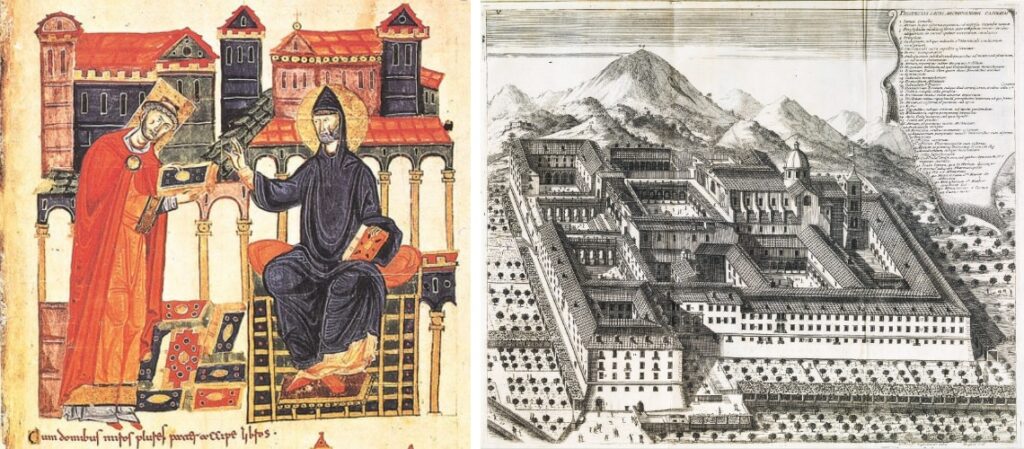
1 – Desiderius symbolically donates the assets of the Abbey of Montecassino to St. Benedict 2 – The Abbey of Montecassino, E.Gattola, Historia abbatiae Cassinensis, Venice 1733

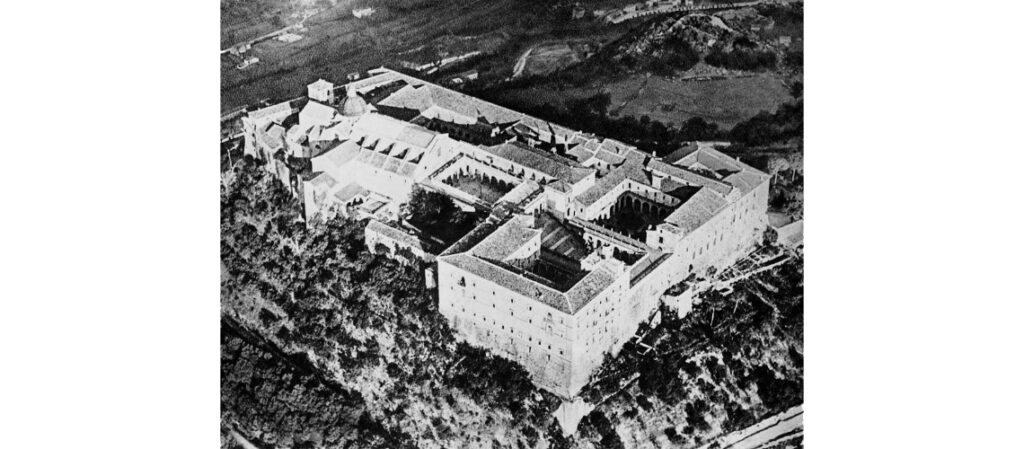
3 – The Abbey of Montecassino before its destruction in 1943

It is the second gate in chronological order, created in Constantinople and shipped to Montecassino. Like the one in Amalfi, it was built by nailing panels and frames to a heavy, thick wooden frame.

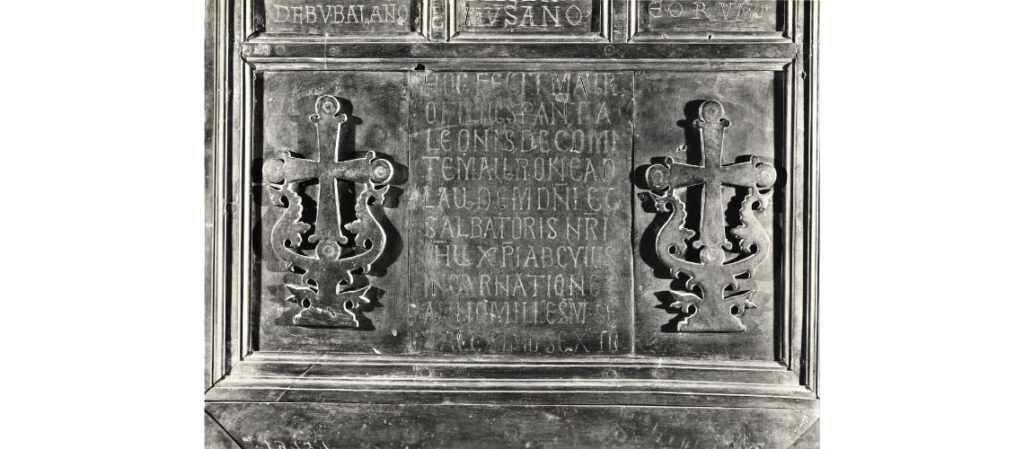
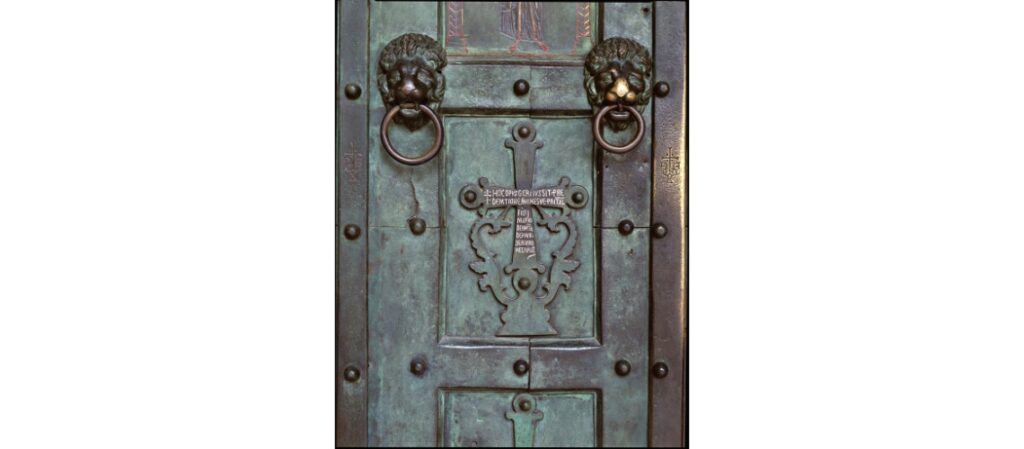
The door has two dedicatory inscriptions at the bottom (flanked by flat crosses similar to those of Amalfi), the left one bears the name of the donor Mauro di Amalfi and the date 1066, the year of their execution [Photos 4, 5, 6, 7, 8].
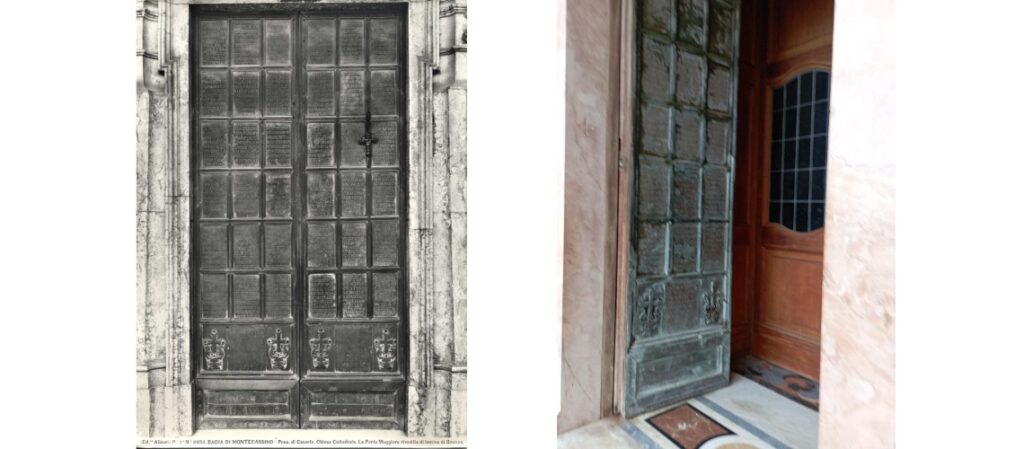
4 5

6

7

8

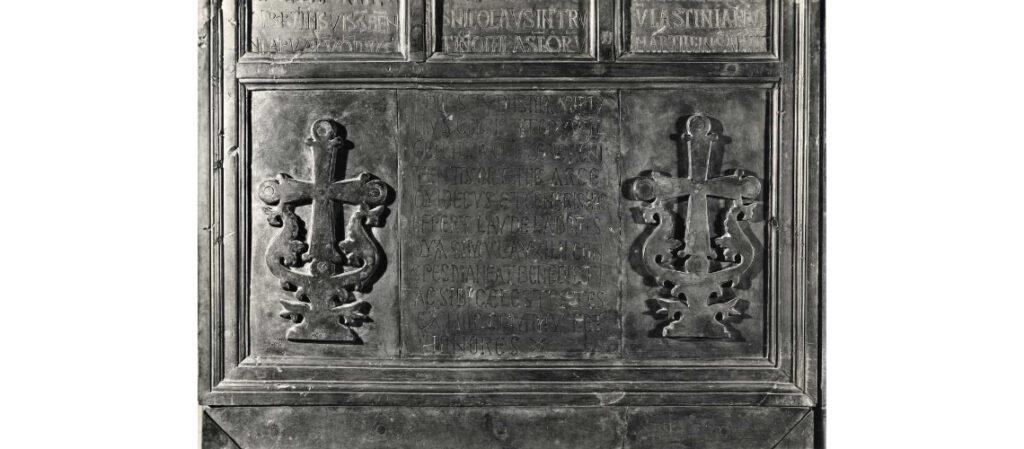
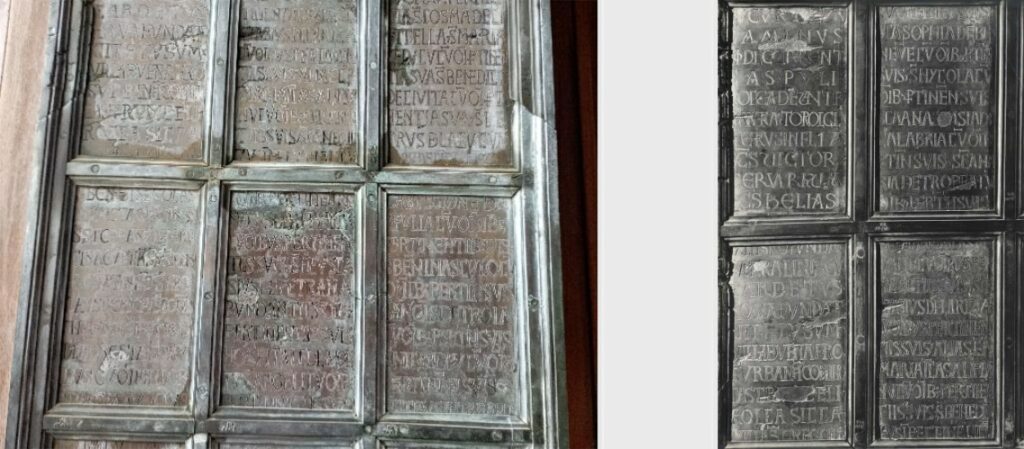
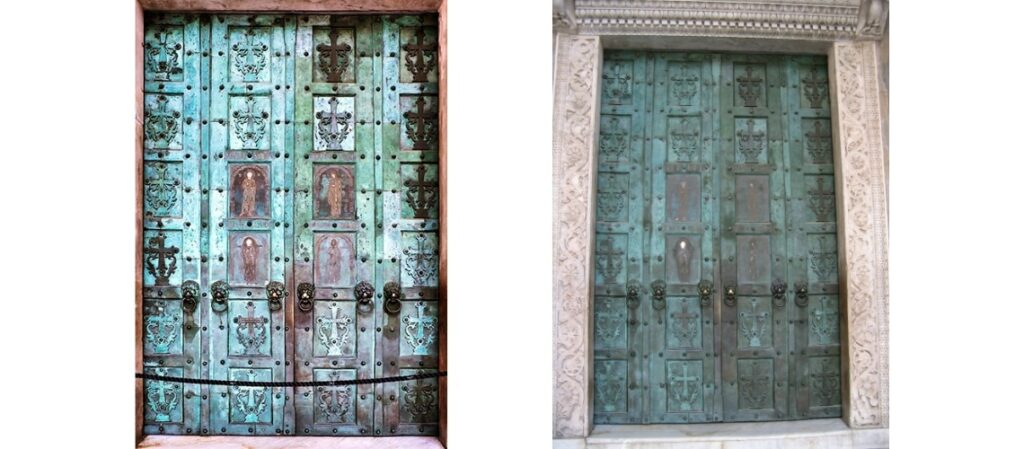
Above these, the doors are occupied by 18 panels each inscribed with the list of the monastery’s possessions [Photos 9, 10, 11, 12]. However, it should be noted that the typology of the decorations on the doors of Amalfi and Montecassino is very different: in Amalfi the four central panels are inlaid with Christ, the Virgin, St. Andrew and St. Peter, all the other panels feature flat crosses; in Montecassino the door is practically a long inscription with only four of the crosses at the bottom. It is very unlikely that Desiderio requested 36 panels all inscribed with the 180 possessions of Montecassino. The study of this list has highlighted that 26 of the 180 possessions inscribed on the door were purchased by Montecassino after 1066, most of which after the death of Desiderio (1087). But the current form of the gate and its dating are highly controversial:
the “Chronica monasterii Casinensis” reports that in 1123: “around this time Abbot Oderisio ordered the beautiful bronze door at the entrance of our church to be made.” It is very likely that the origin of the gate bearing the list of Montecassino’s possessions is due to Abbot Oderisio II, who ruled the Abbey from 1123 to 1126.
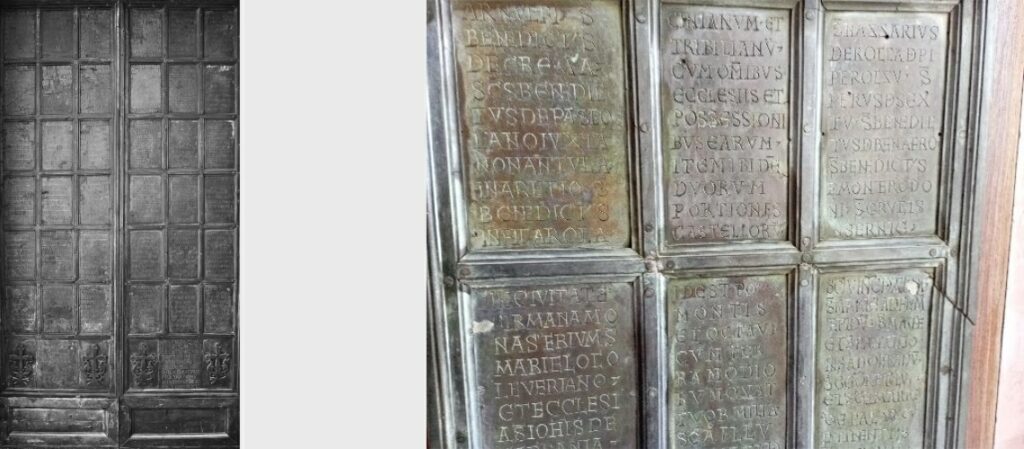
9 10
11 12

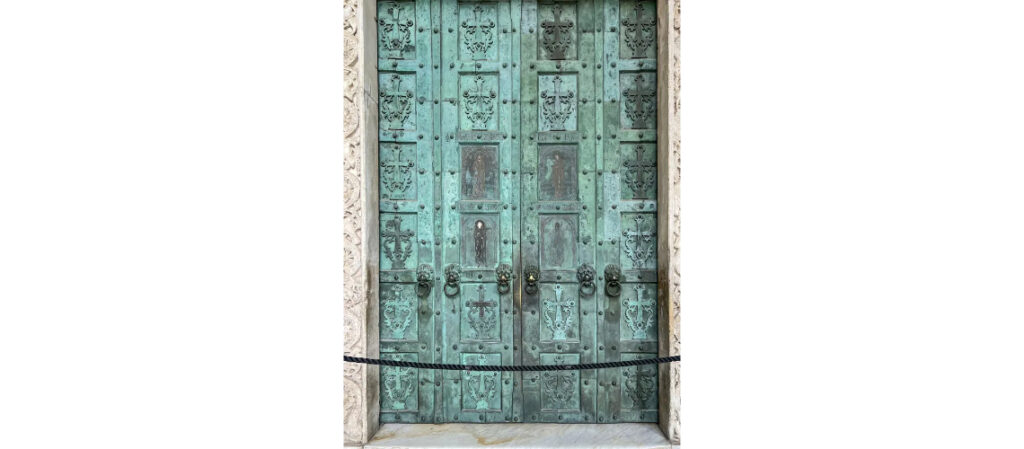
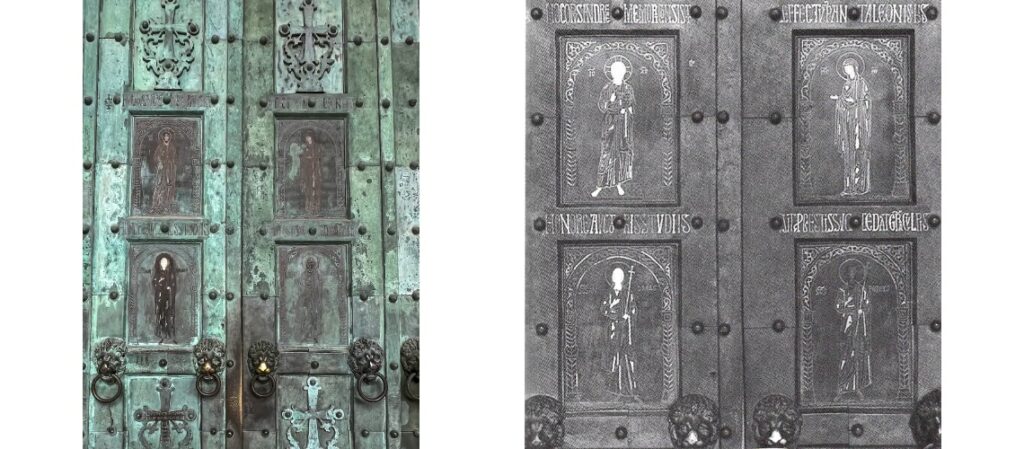
When Montecassino was bombed in 1944, the door panels had come loose, and it was discovered that eight of them had inlaid figures of saints and prophets on the back [Photos 13, 14, 15, 16, 17]: the Desiderius door, which came from Constantinople, with Byzantine inlaid panels and built just a few years after the Amalfi one, must have been dismantled and reassembled with the panels turned, on which the inscriptions with the properties of the Montecassino monastery had been engraved; the reassembly with the turned panels and the inscriptions is probably what is attributed to Oderisius II in the “Chronica monasterii Casinensis” in 1123.
The two large panels at the base of the doors, with the crosses, were added by Desiderius to make the door, which had been ordered too small, appropriate for the size of the entrance.
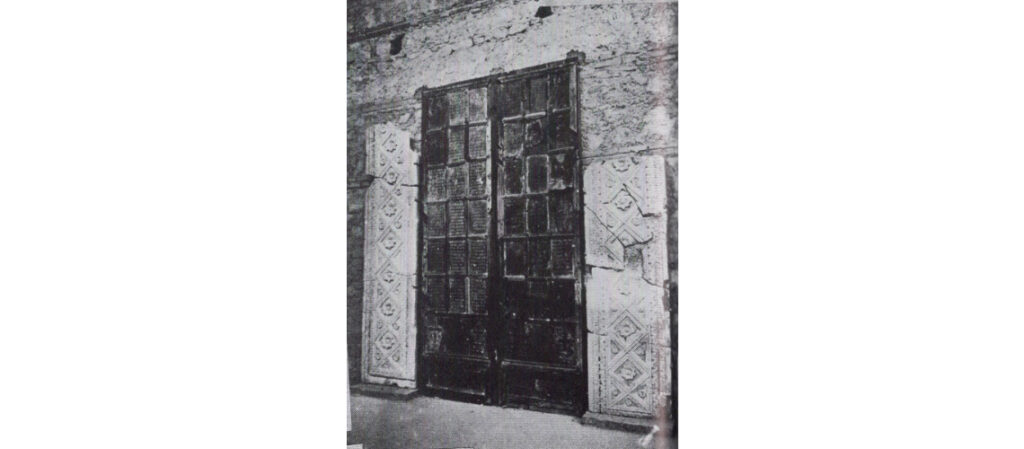
13-Door reassembled after the bombing of 1944
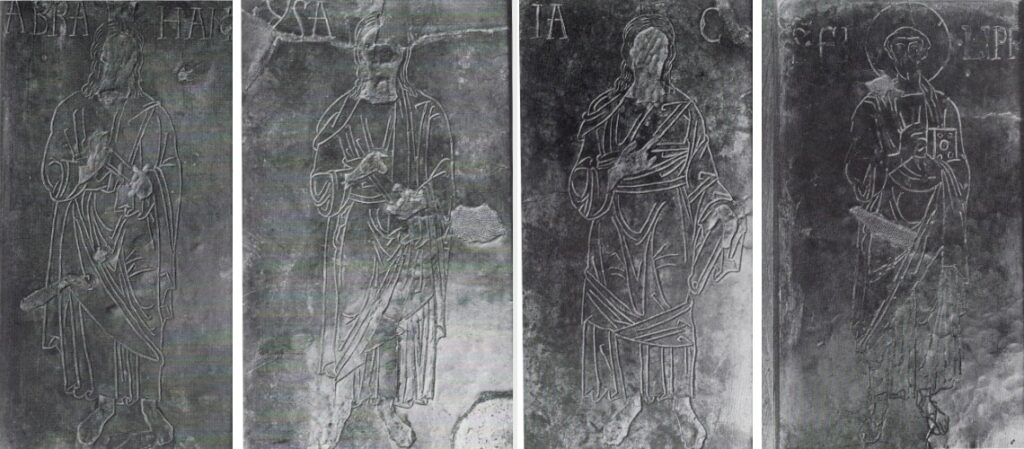
14 15 16 17

THE DOOR OF AMALFI CATHEDRAL

Bronze doors in Italy made in Constantinople

Of the ten bronze doors made in Constantinople and sent to Italy, only eight remain in their original locations: in the Amalfi Cathedral, in the Abbey of Montecassino, in San Paolo fuori delle Mura in Rome, in San Michele Arcangelo on Monte Sant’Angelo, in San Salvatore de Birecto in Atrani (moved to the collegiate church of Santa Maria Maddalena), in the Cathedral of Salerno, in the central door of San Marco in Venice, and in the door of San Clemente. The one from 1099, sent as a gift by Godfrey of Bouillon and placed at the entrance to the façade of Pisa Cathedral, was destroyed in the fire of 1595, and the one from the Basilica of San Martino in Montecassino (mentioned in the Abbey’s “Chronica”) was also lost.
Constantinople was the Mediterranean center of luxury goods production and trade, and was particularly renowned for its metalwork. Yet incredibly, no similar gate has survived, either in the metropolitan area or anywhere else in the empire; only the seven gates that reached Italy are known.

While Carolingian and Ottonian (or even Romanesque) gates are solidly cast, Byzantine gates are made of thin panels (about 3 millimeters thick) separated and nailed to a wooden frame. The individual panels were enclosed by modular frames (flat, as in the Amalfi Cathedral, or semi-circular or cordoned) [Photo 1] whose pieces were also nailed to the wood. Ultimately, they were wooden doors covered with thin panels and brass frames.

Photo 1

The Byzantine doors do not have any raised parts, with the exception of the lion heads supporting the door knocker. The aim was to create a shiny, pictorial and not plastic surface, unlike that of the medieval doors created in the West.

The Amalfi Door

The first of the group was that of Amalfi Cathedral, commissioned around 1060 by the very wealthy Amalfi nobleman Pantaleone de Comite Maurone, who had settled in the Constantinopolitan merchant colony founded by the Amalfi people in the 9th century. The most influential figure in the colony, he had been awarded the titles of “hypatos” and “dishypatos” (consul and consul again) by the Byzantine imperial court.

Pantaleone donated it to the cathedral of his hometown, dedicating the gate to Saint Andrew for the forgiveness of his sins and the redemption of his soul, as appears from the inscription engraved on the cross in the panel below that of Saint Andrew, along with his family lineage [Photos 2, 3]. We know that the cross in the panel below that of Saint Peter (now lost and replaced with a plain cross) bore the inscription in Latin and Greek with the name of the founder, Simeon.

Photo 2 Photo 3

It consists of twenty-four brass panels (not actually bronze, but brass, as the alloy contains a high percentage of zinc): Byzantine doors were normally cast in brass, which, thanks to its yellow color, shone with golden reflections and were therefore not patinated but rather continuously washed to keep them shiny. Of these, twenty panels have applied flat, smooth, thin crosses, probably sand-cast, each secured with four hemispherical-headed pins [Photo 4].

Photo 4

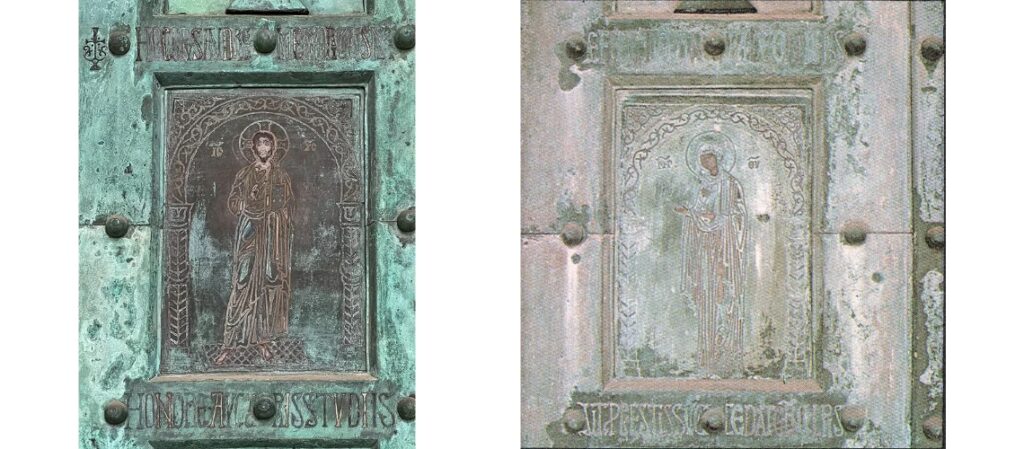
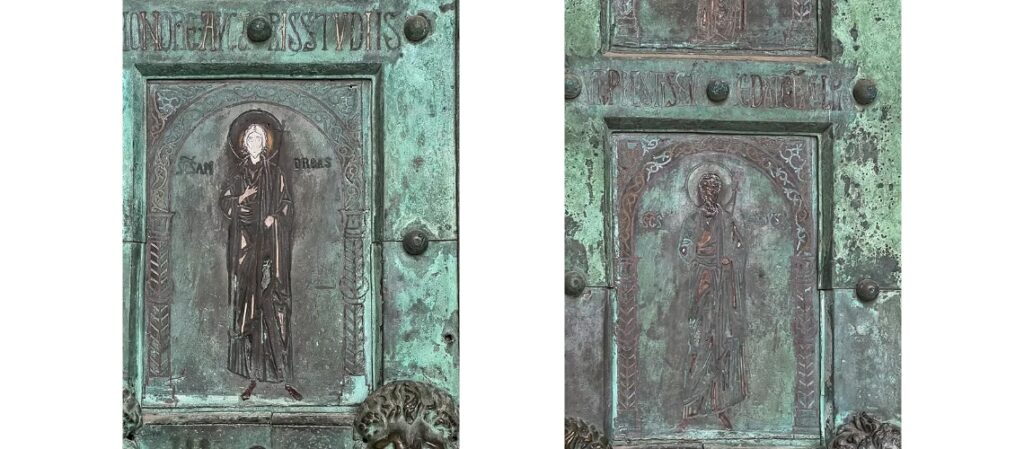
The four central panels [Photos 5,6] instead have inlaid copper and silver figures of Christ [Photo 7] and the Virgin at the top [Photo 8], of Saint Andrew [Photo 9] and Saint Peter [Photo 10] at the bottom, under arches supported by two columns. The inlaid engraving was done cold on the smooth sheets of the panels which had also already been sand-cast.

Photo 5 Photo 6
Photo 7 Photo 8
Photo 9 Photo 10

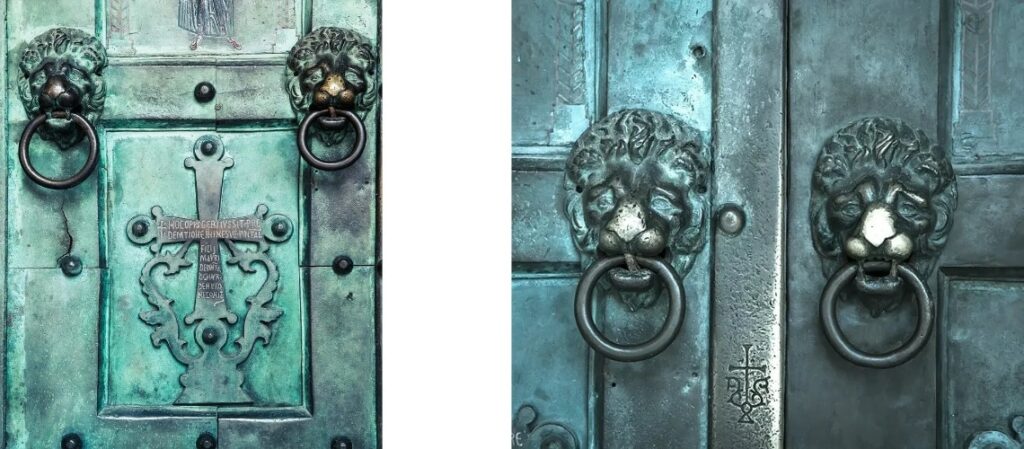
Six lion heads were applied to support the door knocker, the only elements in plastic relief in the entire work [Photo 11, 12].

Photo 11 Photo 12