Lorenzo Ghiberti and the Gates of Paradise - Part 2
The Preceding Years
Upon receiving news in Pesaro from his friends in Florence about the competition for the second set of doors for the Florence Baptistery (according to Vasari, it was Bartoluccio who sent him the information), Ghiberti requested leave from Malatesta, the lord of Pesaro—for whom he was then working as a painter—and departed for Florence.
In addition to Lorenzo Ghiberti, those who presented themselves at the “Opera di San Giovanni” (the administrative body for the Baptistery) for the competition announced in 1401 included the goldsmiths Filippo Brunelleschi—then twenty-four years old—Simone da Colle Valdelsa, and Niccolò di Luca Spinelli d’Arezzo, as well as the sculptors Jacopo della Quercia, Francesco di Valdambrino, and Niccolò Lamberti. In his “Commentarii”, Lorenzo notes that one of these individuals withdrew, leaving “six of us to undertake the said trial.” [Photos 1, 2, 3, 4]
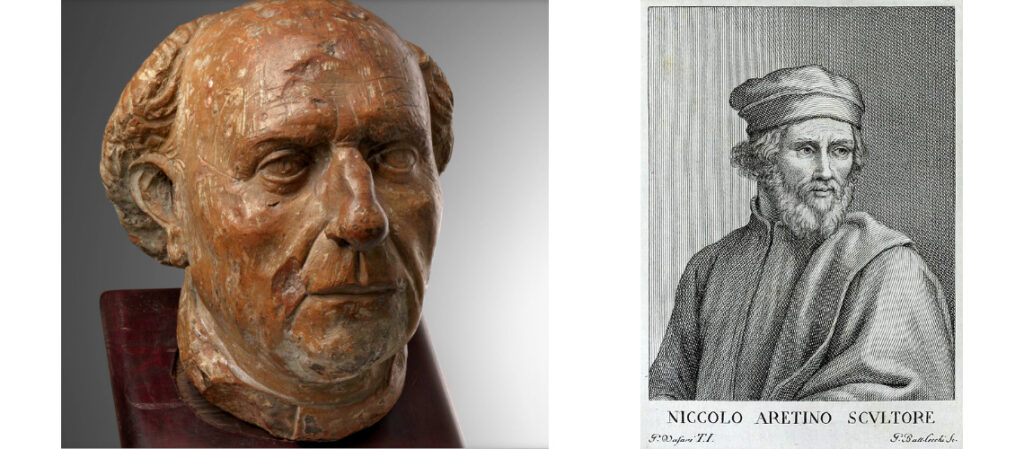
| 1-Andrea di Lazzaro Cavalcanti, Terracotta portrait of Filippo Brunelleschi | 2-Niccolò di Luca Spinelli of Arezzo |
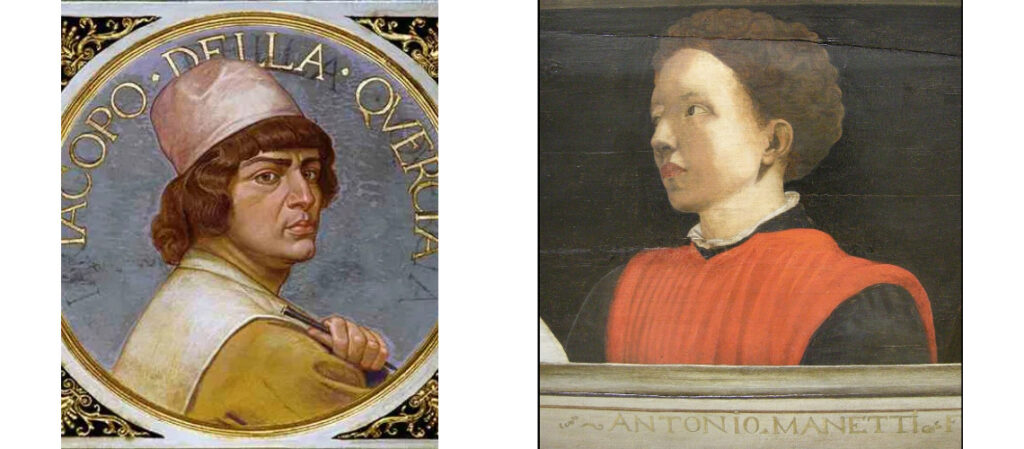
| 3-Jacopo della Quercia | 4-Paolo Uccello, Portrait of Antonio Manetti, first half of the 16th century |
The test consisted of executing and casting in bronze—within one year—a panel identical in its dimensions and Gothic-style frame to those of the first set of Baptistery doors, which had been created by Andrea Pisano. The subject was to be the Sacrifice of Isaac; the bronze alloy was provided by the overseers of San Giovanni. According to Ghiberti, the jury was composed of 30 “highly skilled men—painters and goldsmiths/sculptors”—along with 4 consuls of the Arte di Calimala (the guild that oversaw the work at the Baptistery). Ghiberti emphasizes, more than once, that “the palm of victory was awarded to me by all the experts and by all those who competed against me.” [Photos 5, 6].
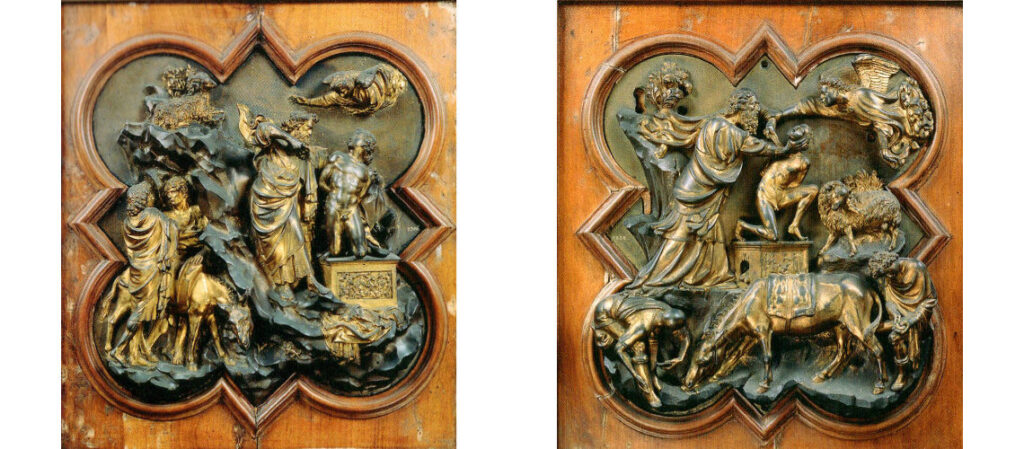
| 5-Ghiberti, competition panel for the North Doors of the Baptistery | 6-Brunelleschi, competition panel for the North Doors of the Baptistery |
Antonio Manetti, a biographer of Brunelleschi, recounts a rather different story in his *Notizia di Filippo di ser Brunelleschi*, written between 1482 and 1489:
The only competitors admitted by the jury to the final trial were Ghiberti and Brunelleschi. The latter, who “possessed the craft with great vigor,” completed his bronze panel “quickly” and, without saying a word to anyone, “waited for the time of the comparison.” Ghiberti, by contrast, “proceeded slowly,” seeking advice from the very goldsmiths, painters, and sculptors who were to serve as the competition’s judges. “As many times as those with the greatest expertise suggested, he would undo and redo parts—or even the whole—of the work, sparing no effort while it was still in wax; he took a long time to bring it to completion, and then the moment for the comparison and judgment arrived. The overseers and officials of the project sought counsel from the very individuals whom Lorenzo had consulted—men who were, in truth, the most knowledgeable (and perhaps the only ones qualified to judge), and who had, in fact, visited Lorenzo’s workshop on several occasions.” Unable to decide between the two, the judges proposed awarding the commission for the doors to both artists jointly. “Filippo and Lorenzo were summoned, and this proposal was put to them; Lorenzo remained silent, but Filippo refused to agree unless the entire project were entrusted to him alone.” Consequently, the commission was awarded to Ghiberti.
The contract for the commission of the doors was signed on November 23, 1403; the document was drawn up between the *Arte di Calimala* (the Guild of Merchants) on one side, and Ghiberti’s father, Lorenzo di Bartolo, along with Bartolo di Michele—both goldsmiths—on the other. [Photos 7, 8]
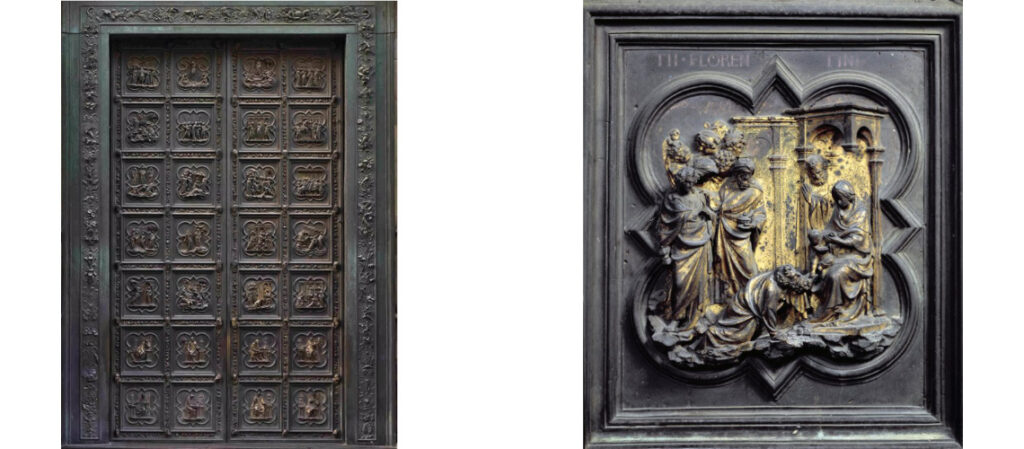
| 7-Ghiberti, North Door | 8-Ghiberti, North Doors, panel depicting the Adoration of the Magi, 1403–24 |
On the North Door, Ghiberti included his own portrait among the small heads set within the frames—depicting himself with a cloth wrapped around his head, as was the custom among artisans. [Photo 9]
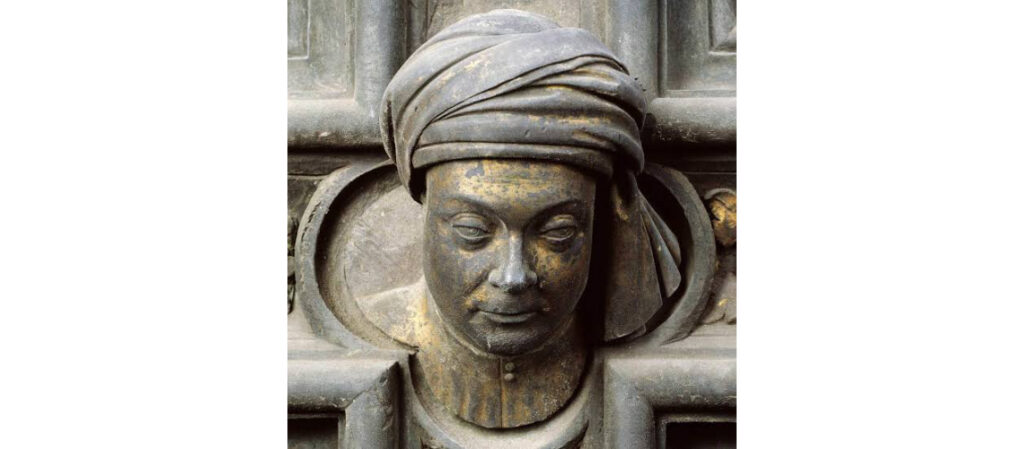
9-Ghiberti, North Door, his self-portrait in artisan attire