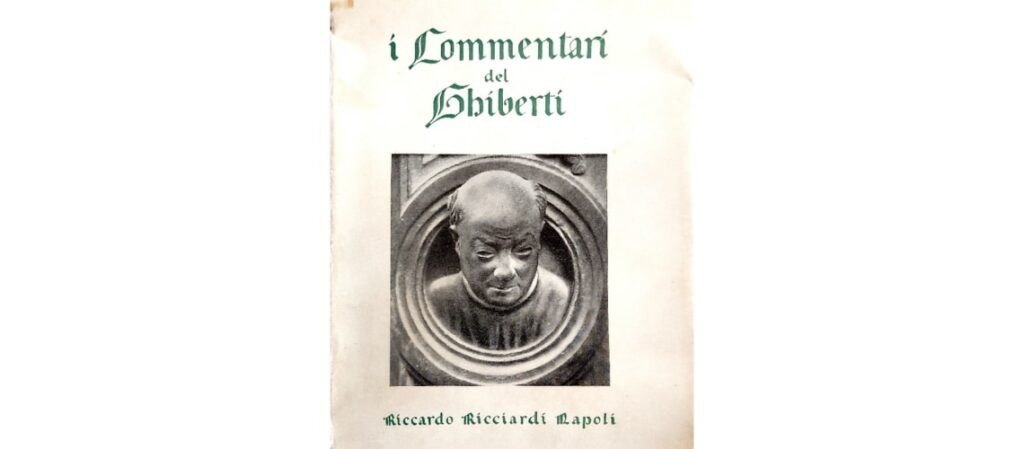
Lorenzo Ghiberti and the Gates of Paradise
Previous Years
Lorenzo Ghiberti was a prominent figure in Florence, so much so that on March 17, 1334, he was proposed for the office of *buonuomo* (literally “good man” or councilor). Indeed, on June 22, 1321, twelve such *buoniuomini* had been appointed to work alongside the Priors, the Gonfalonier of Justice, and the Gonfaloniers in deliberating on major issues, effectively becoming directly responsible for Florentine policy. [Photos 1, 2]
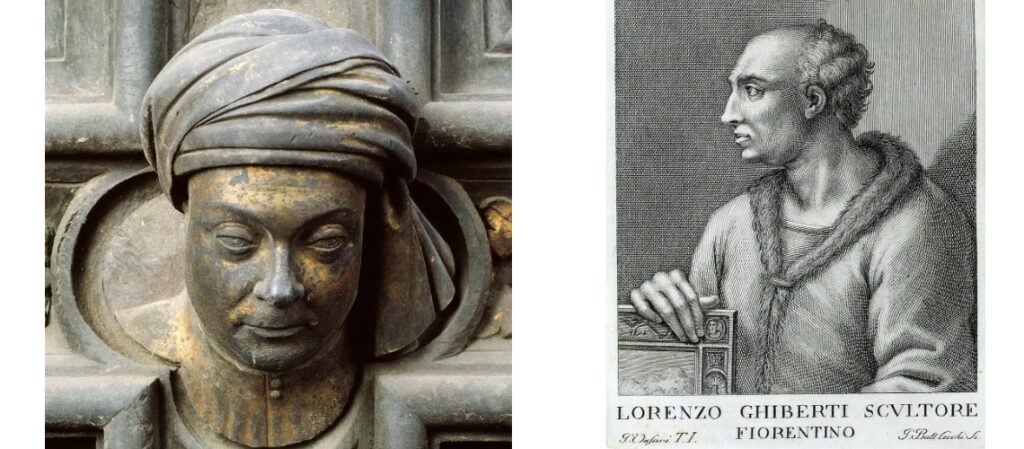
| 1 – Self-portrait of Lorenzo Ghiberti in the frames of the North Doors of the Baptistery | 2 – 18th-century engraving of Lorenzo Ghiberti |
This proposal triggered a complex and dangerous situation for Lorenzo; indeed, on March 17, 1344, two *tamburazioni* were lodged against him—that is, anonymous denunciations dropped into special tube-shaped boxes or urns (known as *tamburi*) located near the magistrates’ offices. It was alleged that Lorenzo Ghiberti was the illegitimate son of the goldsmith Bartolo di Michele (known as Bartoluccio) and Monna Fiore—the daughter of a laborer from the Val di Sieve and the wife of Cione di Ser Bonaccorso Abatini, whom she had married at San Clemente in Pelago. Monna Fiore, evidently unhappy in her marriage, fled Pelago and arrived in Florence in 1374; there she met Bartolo and bore him two children—a daughter and, in 1378, a son, Lorenzo—who grew up in Bartolo’s household and learned the goldsmith’s trade.
News of these two denunciations threatened to prevent Lorenzo from being elected a *buonuomo* (a civic official), so he began to prepare a counter-move: he filed an appeal presenting the marriage certificate of Cione and Monna Fiore (dated 1370) and asserting that he had been born in 1378 *constante matrimonio inter predictos*—that is, while the marriage between the aforementioned parties was still in effect—thereby declaring himself to be Cione’s son. During the *tamburazioni* (secret denunciations), it was also alleged that neither he nor his family had ever paid taxes in Florence—another reason for his ineligibility—but Lorenzo presented proof of tax payments made in 1375 by Cione di Ser Buonaccorso (of the Santa Maria Novella quarter and the Leon Rosso *gonfalone*), as well as a certificate of his registration with the Guild of Judges and Notaries, dated August 4, 1344.
Lorenzo Ghiberti won the appeal, yet he continued to identify himself as the son of his adoptive father, “Laurentii Cionis de Ghiberti“; indeed, when he completed his masterpiece, the *Gates of Paradise*, he inscribed it with the signature “Laurentii Cionis de Ghibertis“.
Despite all this, in his declarations for the Florentine *Catasto* (tax census) of 1427 and 1442, he stated that he was born in 1381 and was the son of the goldsmith Bartolo di Michele. [Photo 3]
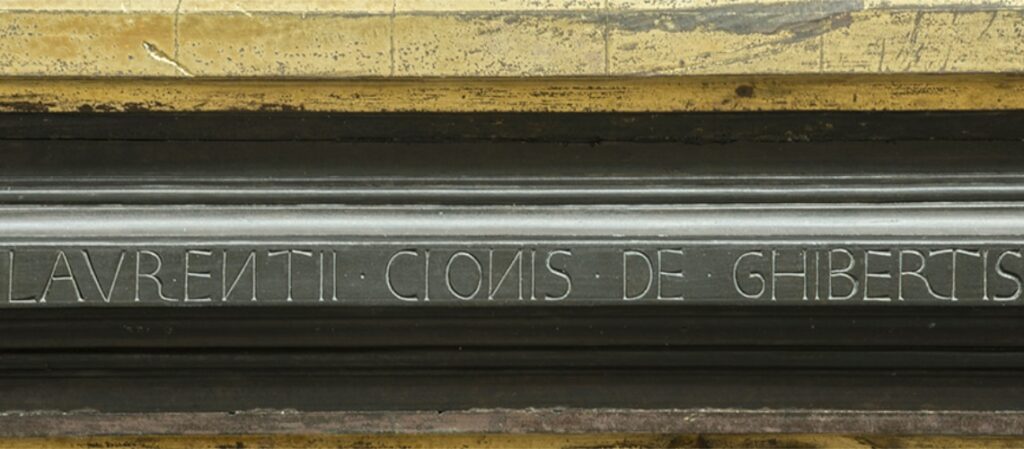
3 – Engraving of Ghiberti’s signature
Lorenzo nasceva tra il 1380 e il 1382 (la data esatta è ancora incerta) nella casa di Bartolo di Cione, che si trovava nella via Nuova di San Paolo, (ultimo tratto dell’ attuale via del Porcellana verso via della Scala) presso l’ Ospedale di San Paolo dei Convalescenti (che si ingrandì negli anni successivi fino ad arrivare in piazza Santa Maria Novella col grande porticato disegnato da Michelozzo), dove visse fino al 1419 circa. [Foto 4,5,6]
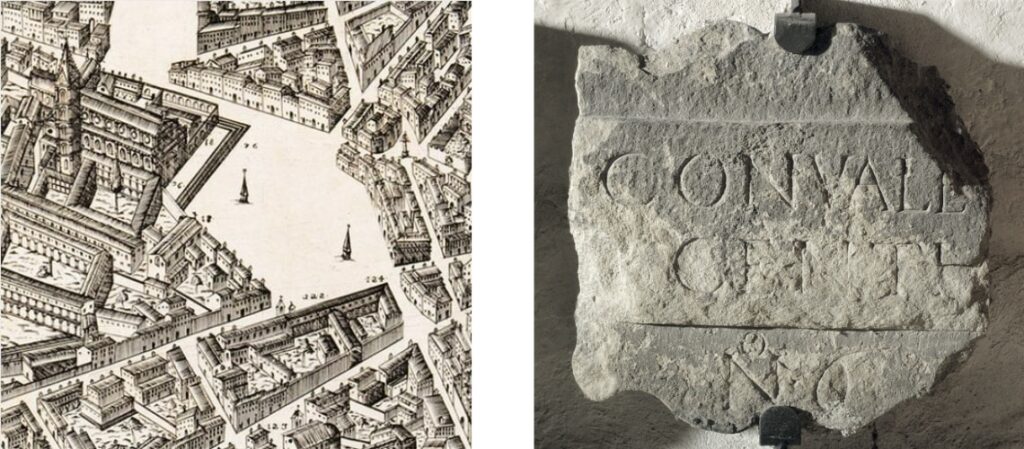
| 4 – Buonsignori Map, 1594, corner of Via del Porcellana and Via della Scala | 5 – Sign of the Hospital of San Paolo dei Convalescenti |
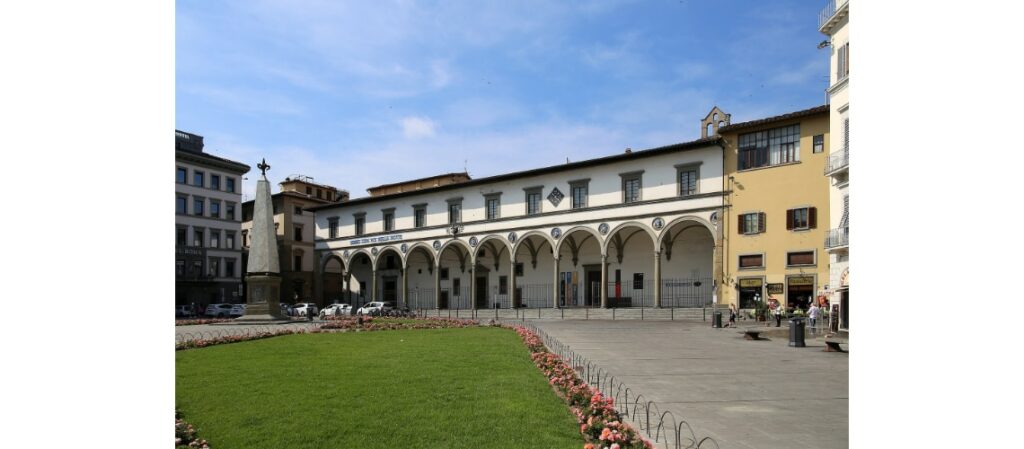
6 – Hospital of San Paolo, loggia by Michelozzo
Sometime between 1452 and 1455, Lorenzo wrote his *Commentari* (the manuscript of which is preserved in the National Library in Florence) in which he recounts how, in 1400, Malatesta IV (known as “dei Sonetti”), Lord of Rimini and Pesaro, summoned him to Pesaro alongside another Florentine painter to fresco a room in his palace; that fresco has since been lost. It was while in Pesaro that he received news from friends in Florence about the competition the city had announced for the second set of doors for the Florence Baptistery. [Photo 7]