THE BRONZE DOOR OF BENEVENTO
The bombing of Benevento in 1943 completely destroyed the Cathedral, and even the medieval bronze door was reduced to fragments. The 1990 restoration, after extensive reconstruction work, allowed the bronze panels to be reassembled and restored, thus reconstructing the cathedral.
[Photos 1, 2, 3, 4, 5, 6, 7]
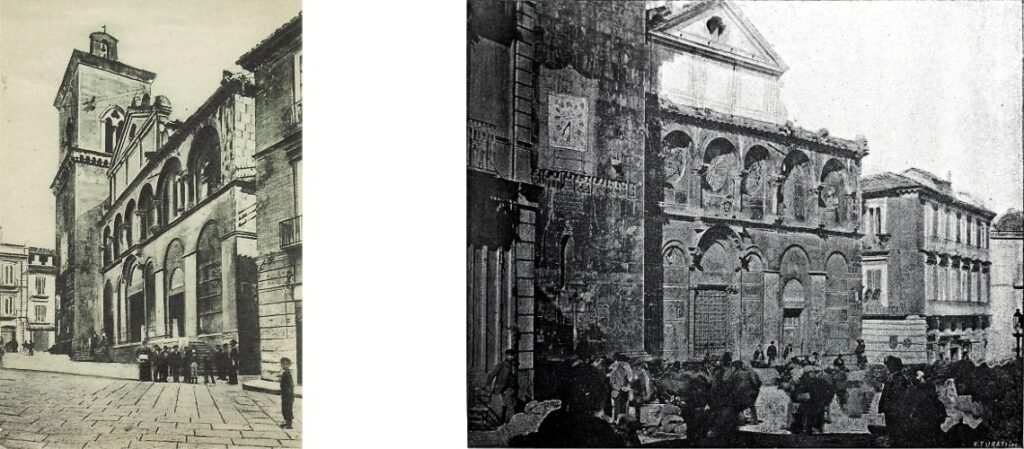
| 1 – The cathedral before 1943 | 2 – The cathedral before 1943 |
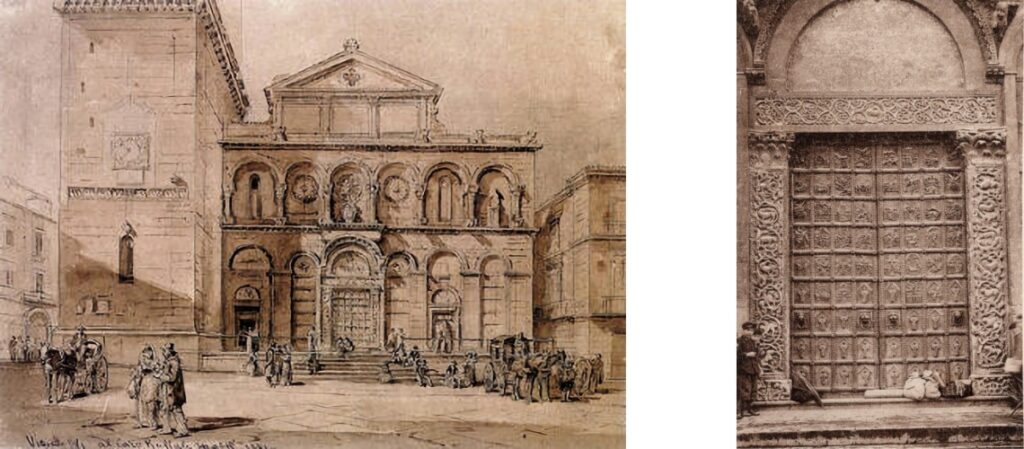
| 3 – A. Vianelli (1803-1894), Facade of the Cathedral of Benevento, Museum of Sannio | 4 – The Cathedral Door before 1871 |
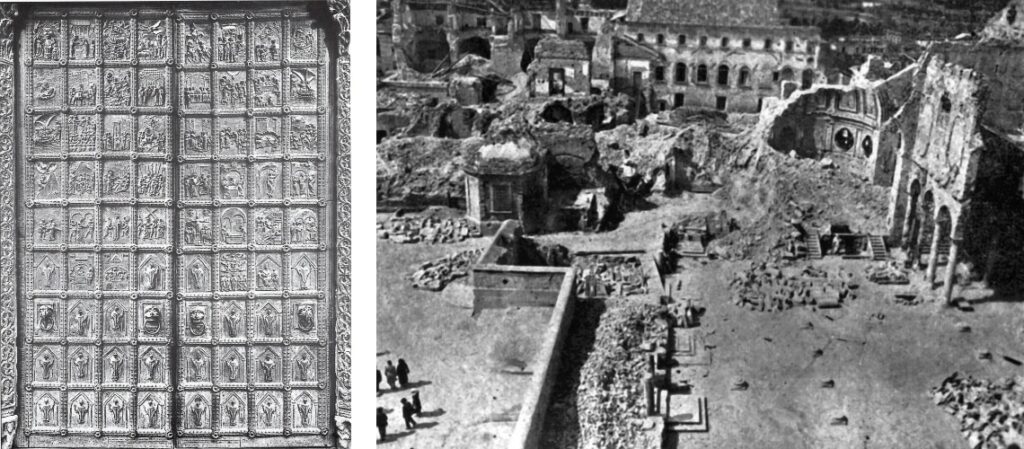
| 5 – The Cathedral Door before the 1930s | 6 – The cathedral after the bombings of 1943 |
7 – The reconstruction of the panels after the bombing
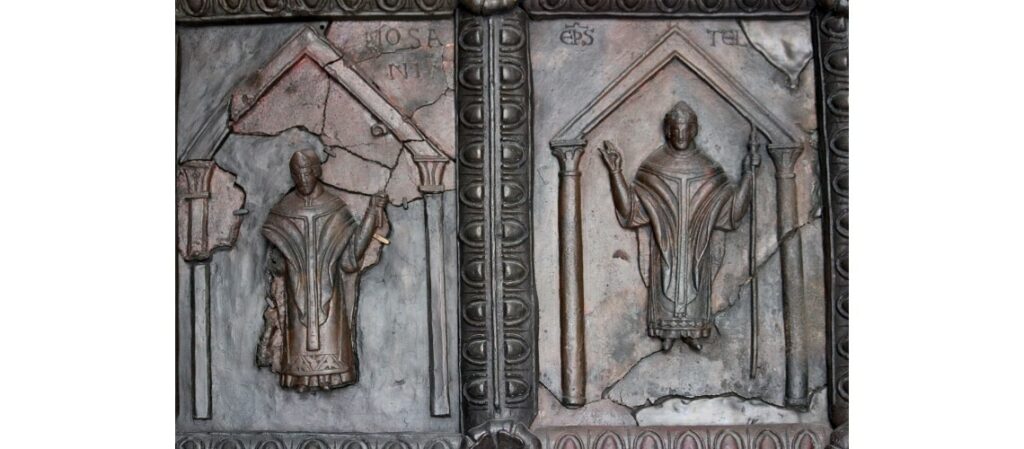
The restoration also revealed that a panel on the door containing the effigy of the bishop of Lesina was hiding, beneath an abrasion, the name Errico, referring to the archbishop of Benevento who reigned from 1157 to 1170; and therefore the other panel, which was believed to represent the presumed archbishop of Benevento in his chair, actually represents the Pope. This discovery led to the door (or at least a large part of it) being dated to 1156. [Photo 8]
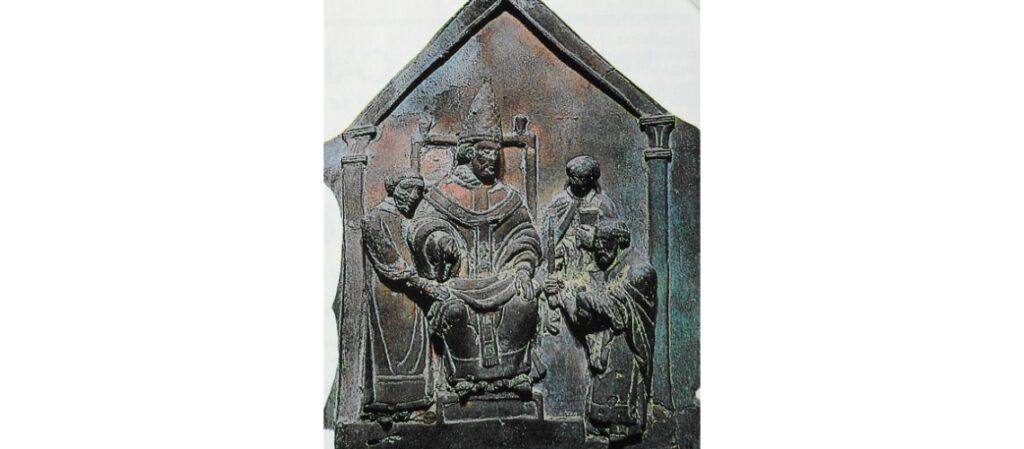
8 – Pope Adrian IV consecrates Bishop Errico
The door is composed of 72 panels and is of remarkable dimensions, 4.60 meters high and 3.23 meters wide, making it the largest of its kind in Europe. Both doors are divided into horizontal registers, each containing eight rectangular panels of the same size, 27.5 x 40 cm.
The panels are attached to a sturdy wooden frame by frames decorated with ovoli that surround them and hold them in place, secured by nails with flower-shaped protomes.
Both doors have two ring-supporting protomes, one of a griffin and one of a lion. [Photos 9, 10, 11, 12, 13, 14, 15, 16, 17, 18]
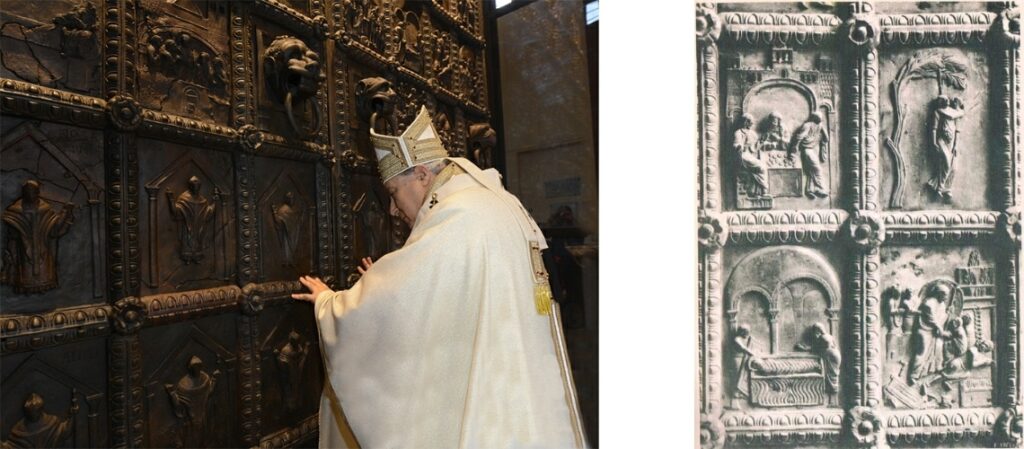
| 9 – Papal visit to the Door | 10 – Original panels before the bombing |
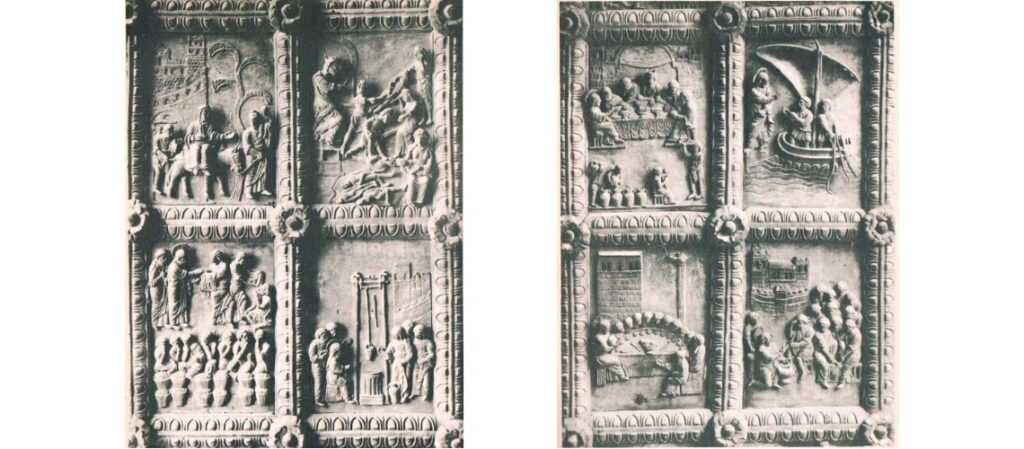
| 11 – Original panels before the bombing | 12 – Original panels before the bombing |
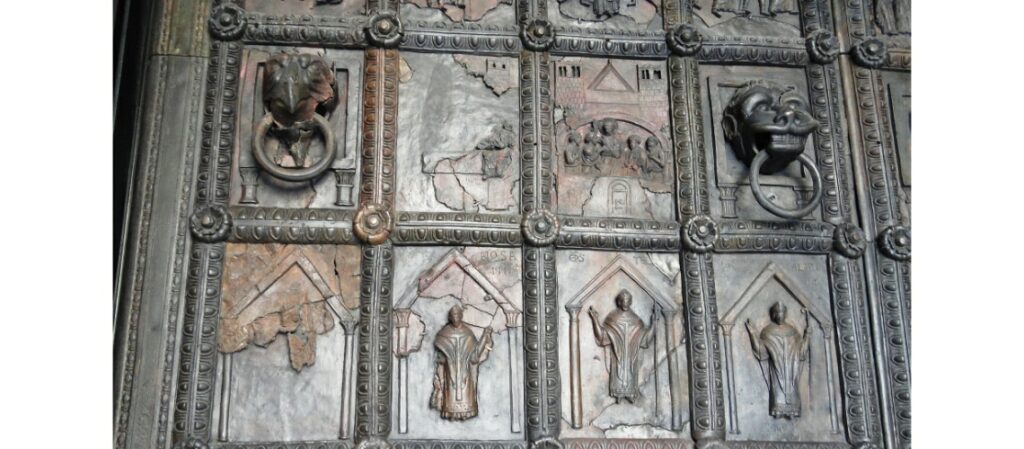
13 – Panels with the heads of lions and griffins
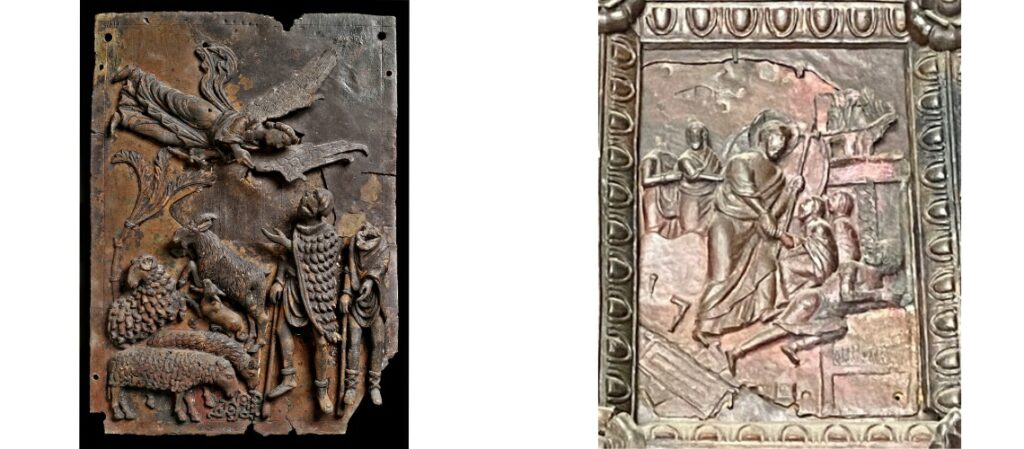
| 14 – Panel with the announcement to the shepherds recovered after the bombing | 15 – Panel with the descent of Jesus into limbo |
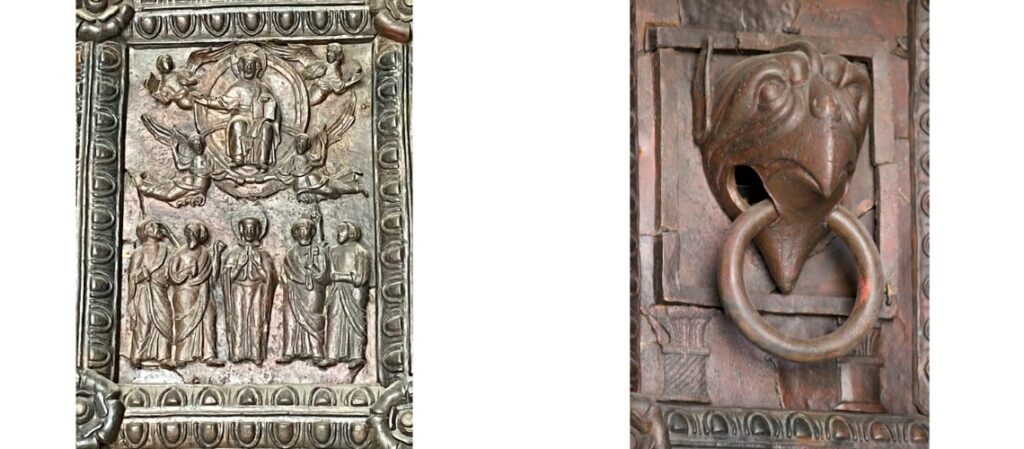
| 16 – Panel with the ascension | 17 – Griffin protome holding ring |
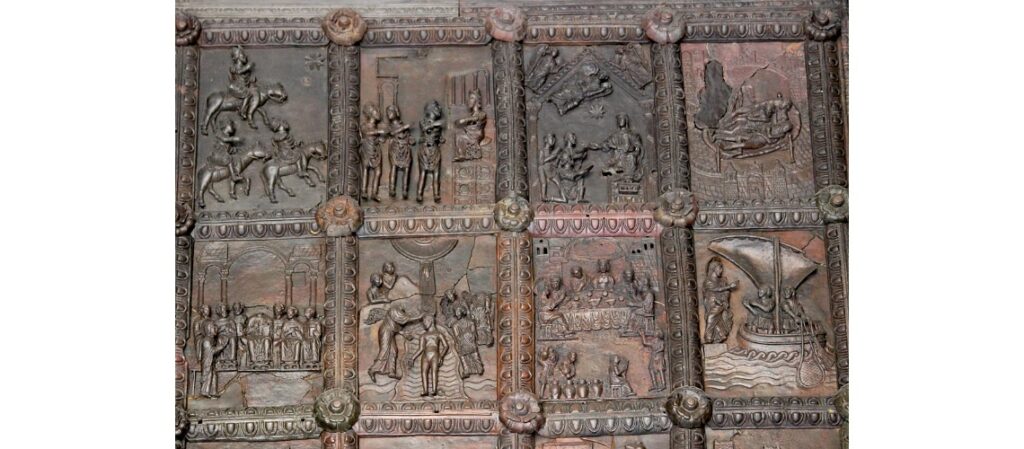
18 – Panels with the story of the Magi and the beginning of Jesus’ public life
The panels, cast using the lost-wax process, are in bas-relief, some with many highly high-relief sections partially detached from the background. Groups of figures appear to derive from the religious theater of the 11th-12th century.
Their style, although still Romanesque, is distinctive: the details of some figures are very accurate, the movements, poses, and compositions with their backgrounds and architecture are “modern” compared to the Romanesque style.
The first five rows of the upper part of the door feature themes drawn from the canonical Gospels, the Apocryphal Gospels, and the Acts of the Apostles. There are no Old Testament themes, nor representations of prophets, apostles, or saints. In the other four rows below, there are only three panels inspired by the Gospels. The remaining ones depict the Pope in his chair consecrating a bishop. Next comes Archbishop Errico of Benevento, his 23 suffragans, and four protomes with ring holders bearing lion and griffin heads.
[Photos 19, 20, 21, 22]
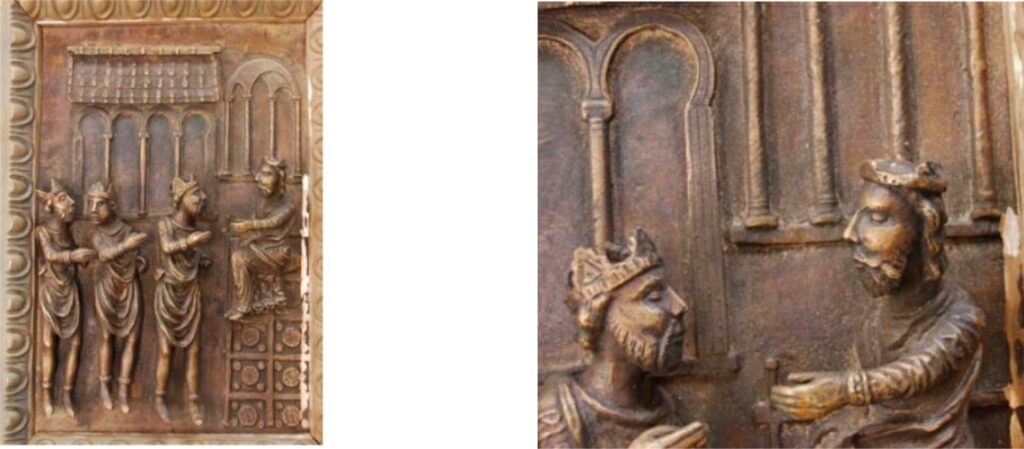
| 19 – Panel of the Magi before Herod | 20 – Panel of the Magi before Herod, detail |
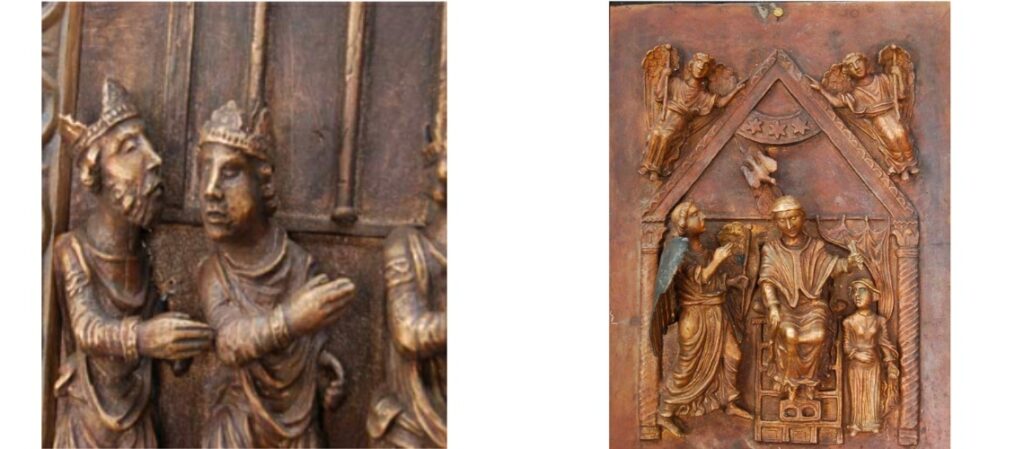
| 21 – Panel of the Magi before Herod, detail | 22 – Panel with the Annunciation |